

19 March 2026
●
1 min read

Over $21 billion in capital sits in onchain treasuries today. A significant portion,estimated at a 30 to 40%, is held in stablecoins, parked in multisig wallets and custody platforms, generating nothing.
This is not a liquidity problem. It is an infrastructure problem.
The organizations holding this capital,protocols, DAO treasuries, crypto-native funds, and increasingly family offices and institutional allocators, are not avoiding yield because they want to. They are avoiding it because the systems required to deploy capital systematically, safely, and at scale do not yet exist in a form that works for them.
That is changing. And the window to build on the right infrastructure early is open now.
Why Now: The Conditions Are in Place
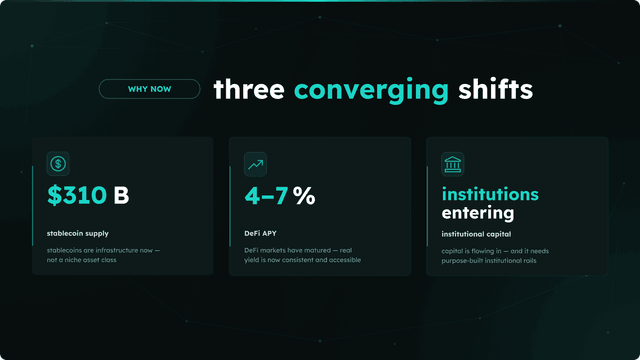
Three converging shifts have made this moment uniquely important for onchain treasury management.
Stablecoins Have Become a Foundational Financial Instrument
Stablecoins are no longer a trading tool. With total supply now exceeding $310 billion and reaching new highs in 2026 ( source: DeFiLlama), they have become the primary settlement asset of the crypto economy -- used for payments, payroll, savings, and cross-border settlement at institutional scale.
As organizations hold larger portions of their balance sheets in stablecoins, treasury management stops being a back-office function and becomes a central operational priority. Capital must be allocated efficiently while maintaining liquidity for payments, operations, and ecosystem spending. The organizations that manage this well will have a measurable financial advantage over those that don't.
Onchain Financial Markets Have Matured
DeFi has moved well past speculative experimentation. Lending markets, rate markets, and structured yield strategies now offer predictable, sustainable returns for stablecoin capital.
Stablecoin lending yields on major DeFi platforms currently range between 4 and 7% annually, relatively stable returns compared to earlier liquidity mining cycles, and increasingly competitive with traditional fixed income.
The overall DeFi ecosystem now processes billions in daily volume across decentralized exchanges, derivatives platforms, and lending protocols. The financial infrastructure is there. The question is whether treasury teams have the systems to access it systematically.
Institutional Capital Requires Institutional Infrastructure
Crypto funds, fintech firms, family offices, and corporate treasuries are actively exploring DeFi as a source of yield and capital efficiency. Stablecoins in particular have emerged as a natural bridge between traditional finance and onchain markets. But institutional capital operates differently from retail.
Before allocating significant capital onchain, institutions need structured systems for risk management, reporting, custody integration, and treasury oversight. Without that infrastructure, even the most sophisticated allocator is effectively locked out of the opportunity -- not by choice, but by the absence of the right tools.
This is precisely why full-stack treasury infrastructure is emerging as the critical missing layer in onchain finance.
How Treasury Management Works Today: And Why It's Broken
In most organizations, treasury management follows a familiar pattern. Capital is raised through token launches, venture funding, protocol revenue, or ecosystem allocations. A portion is converted into stablecoins for liquidity and operational stability. The rest sits in multisig wallets, custody platforms, or exchange accounts.
From there, one of two things happens: capital remains idle, or it is occasionally deployed into individual DeFi protocols through manual, one-off decisions.
This structure offers simplicity. But simplicity at this scale comes at a cost -- and for organizations managing tens or hundreds of millions in onchain capital, that cost is significant.
Fragmentation
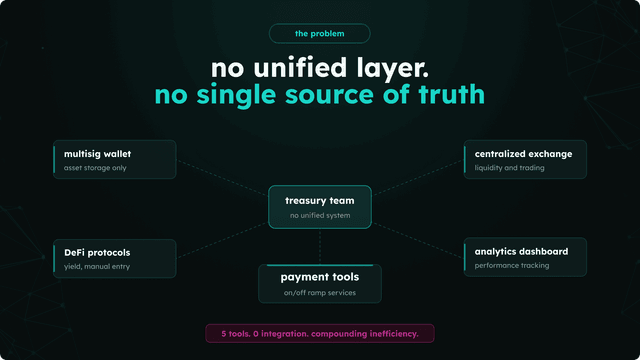
Managing an onchain treasury today means stitching together an ecosystem of disconnected platforms. Most treasury teams operate across a combination of:
- Multisig wallets or custody providers for asset storage
- Centralized exchanges for liquidity and trading
- Individual DeFi protocols for yield and capital deployment
- Analytics dashboards and portfolio trackers for performance monitoring
- Payment tools and on/off ramp services for operational transactions
Each platform solves one narrow problem. None provide a unified operational layer. There is no single source of truth, only a collection of interfaces that don't speak to each other.
This fragmentation becomes increasingly costly at scale. Institutions managing capital across multiple chains, protocols, and liquidity venues face a treasury stack that is distributed, hard to monitor, and difficult to act on cohesively.
The overhead of context-switching across platforms introduces delays, gaps in oversight, and compounding operational risk.
Operational Inefficiency
Even when treasury teams are aligned on a capital deployment decision, execution rarely follows quickly. For DAO treasuries, deploying capital typically requires:
- Drafting and submitting governance proposals
- Community discussion and deliberation
- Voting cycles with fixed timelines
- Multisig approvals before any execution
For startups and funds, the friction looks different but remains significant, internal sign-off processes, manual coordination across exchanges and protocols, and limited automation at the execution layer.
Once a decision clears approvals, the operational overhead continues:
- Bridging assets across chains
- Managing gas fees across networks
- Monitoring open positions across protocols
- Manually adjusting allocations as market conditions shift
These workflows are slow by design, but markets are not. The result is a treasury posture that is reactive rather than strategic, one that struggles to respond to changing conditions or systematically optimize capital allocation over time.
Lack of Systemization
The deepest structural gap in onchain treasury management is the absence of systemization across three critical dimensions: risk, reporting, and organizational integration.
On Risk
Treasury teams are routinely expected to evaluate a complex and evolving set of factors before deploying capital:
- Smart contract security - audits, upgrade mechanisms, exploit history
- Protocol-level risk - governance concentration, dependency chains, systemic exposure
- Liquidity conditions - pool depth, slippage, withdrawal constraints
- Collateralization and liquidation risk - in lending or leveraged strategies
- Yield volatility - sustainability of returns across market cycles
Most treasury teams are not structured as trading desks or DeFi research functions. Founders, operations leads, and DAO participants manage these decisions alongside other responsibilities, often without dedicated frameworks or tooling.
Even when attractive opportunities exist, institutions frequently default to inaction because the risk evaluation burden is too high.
On Reporting
Capital distributed across multiple wallets, protocols, and chains offers no consolidated view by default. Key metrics that should be continuously visible, including:
- Portfolio allocation across assets and protocols
- Yield performance across active strategies
- Liquidity availability and lock-up status
- Risk exposure across venues and counterparties
are instead compiled manually, inconsistently, and often after the fact. This is a significant operational gap compared to traditional finance, where treasury teams operate with real-time, standardized reporting infrastructure as a baseline expectation, not a premium feature.
On Integration
Perhaps the most consequential gap is structural. In traditional organizations, treasury is not a vault; it is an operational financial layer.
It manages liquidity, payments, payroll, vendor transfers, and capital allocation, all within connected systems tied to banking infrastructure. In most crypto organizations, treasury capital sits in multisig wallets or custody platforms that function primarily as storage. Payments and financial operations run through entirely separate tools and workflows.
The treasury is isolated from the organization's day-to-day financial operations, limiting capital efficiency, preventing scalable financial operations, and keeping the treasury from fulfilling its core function.
The Missing Layer: Full-Stack Treasury Infrastructure
The core problem facing crypto treasuries is not complexity. It is the absence of dedicated infrastructure to manage it.
In traditional finance, treasury is not a wallet. It is an operational layer, one that manages liquidity, executes payments, allocates capital across strategies, monitors risk in real time, and produces the reporting that governance and leadership depend on. It is infrastructure, not storage.
That equivalent layer does not yet exist natively for onchain organizations. Until it does, even the most well-capitalized crypto treasury will remain operationally limited. Full-stack treasury management is the answer to that gap.
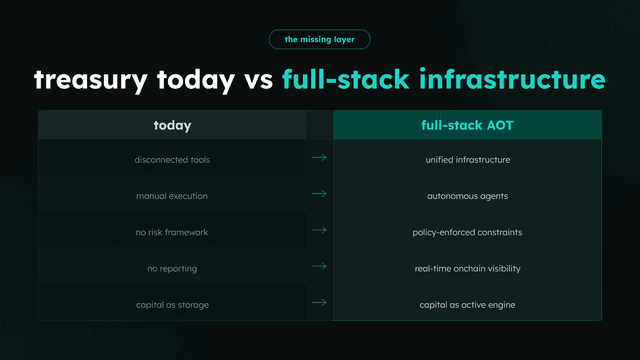
A full-stack treasury system integrates every dimension of treasury activity into a single, coherent infrastructure:
- Custody and security - institutional-grade asset protection across wallets and chains
- Yield curation - curated, risk-assessed strategies across lending, liquidity, and rate markets
- Policy-driven allocation - capital deployment governed by predefined rules and risk parameters
- Automated execution - strategies deployed and adjusted across venues without manual intervention
- Payment rails - fiat and stablecoin operations for vendors, payroll, and transfers
- Risk monitoring and insurance - real-time exposure tracking with protocol-level coverage where available
- Reporting and governance - consolidated dashboards and audit-ready records for stakeholders
In this model, treasury stops being a passive pool of capital and becomes an active financial engine, systematic, protected, and operationally integrated. For protocols, project treasuries, and allocators managing real balance sheets with real obligations, this is no longer a nice-to-have. It is the infrastructure layer that makes everything else work.
The Architecture of a Full-Stack Treasury Stack
If the treasury is to function as a true financial system, it needs infrastructure that manages the entire lifecycle of capital — from how funds enter the system to how they are deployed, protected, monitored, and reported.
A full-stack treasury stack is not a collection of tools. It is a sequenced, integrated architecture where each layer builds on the last. Below is how that system is structured.
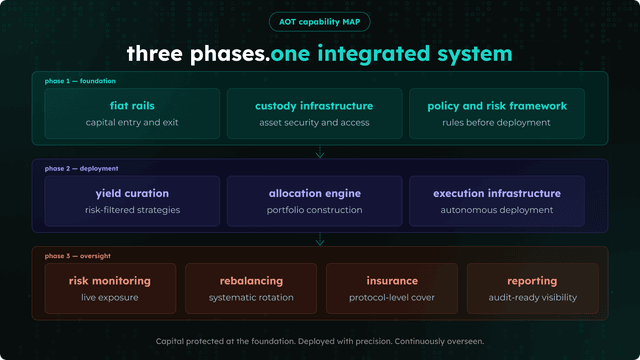
Phase 1 - Foundation: Getting Capital In and Keeping It Safe
Before any capital can be allocated or deployed, three things must be in place: reliable entry points into the onchain system, secure storage, and a clear policy framework that governs how capital can move.
Fiat Rails and On/Off Ramps connect the organization's traditional financial infrastructure to its onchain treasury. Capital needs to flow cleanly between bank accounts and blockchain networks for onboarding treasury funds, offboarding for operational expenses, and enabling global payments and settlements.
Without this connectivity, treasury capital remains isolated from the broader financial system.Custody Infrastructure determines how assets are secured once onchain.
Whether through multisig wallets, MPC-based solutions, or institutional custody providers, this layer establishes the access controls, authorization policies, and transaction approval mechanisms that govern how treasury funds can move. Security without operational flexibility is a vault.
The right custody layer provides both.
The Policy and Risk Framework is where the organization defines the rules before capital is ever deployed. This includes exposure limits per protocol, acceptable asset allocations across stablecoins and volatile assets, liquidity buffers for operational needs, and approved venues for capital deployment.
A well-constructed policy framework ensures every subsequent decision is made within clearly defined boundaries, not improvised under pressure.
Phase 2 - Deployment: Allocating and Executing With Precision
With a secure foundation in place, the system turns to where and how capital should work.
Yield Curation is the process of identifying, evaluating, and maintaining a curated set of strategies appropriate for the treasury's risk profile. Rather than exposing teams to the full complexity of DeFi markets, a full-stack system surfaces risk-assessed opportunities across lending markets, rate strategies, liquidity provision, and staking, filtered against the organization's policy framework.
Strategy Allocation Engine takes those curated opportunities and constructs a portfolio, one that balances risk-adjusted returns with the liquidity requirements of the organization. Capital is not deployed uniformly.
It is allocated with an awareness of concentration risk, liquidity constraints, and yield sustainability across market conditions.
Execution Infrastructure handles the operational mechanics of actually deploying that capital, interacting with smart contracts, routing transactions across protocols, and ensuring positions are created efficiently and consistently across venues. This layer removes the manual overhead that makes treasury operations slow and error-prone, replacing it with reliable, scalable execution.
Phase 3 - Oversight: Monitoring, Protection, and Reporting
Capital deployed across onchain markets requires continuous oversight. This is where most treasury operations today are weakest and where a full-stack system creates the most differentiated value.
Risk Monitoring and Controls provide continuous visibility into protocol exposure, yield changes, liquidity availability, and potential smart contract or market risks. When thresholds are breached, the system triggers alerts or automated safeguards, giving treasury teams the ability to act before problems compound rather than after.
Rebalancing and Optimization ensures that treasury allocations remain aligned with organizational objectives as market conditions evolve. Positions are adjusted, capital is reallocated between protocols, and exposures that no longer meet risk or return expectations are exited , systematically, not reactively.
Insurance and Protection are an increasingly critical layer for institutions deploying significant capital onchain.
Coverage mechanisms in DeFi have matured considerably, and for family offices, project treasuries, and allocators operating at scale, protocol-level protection is no longer optional; it is a baseline risk management requirement.
A full-stack system incorporates this layer directly, rather than treating it as an afterthought.
Reporting, Analytics, and Governance closes the loop. Treasury teams and their stakeholders need real-time visibility into portfolio allocation across assets and protocols, yield performance across strategies, liquidity available for operations, and overall treasury health and risk exposure.
This layer transforms raw onchain data into the structured, audit-ready reporting that governance processes and institutional oversight require.
Together, these three phases form a complete treasury operating system, one where capital is protected at the foundation, deployed with precision, and continuously overseen at scale.
This is what full-stack treasury infrastructure looks like in practice. And it is the standard against which any serious treasury solution should be measured.
Agentic Onchain Treasury (AOT): Full-Stack Treasury Infrastructure, Built for Onchain Capital
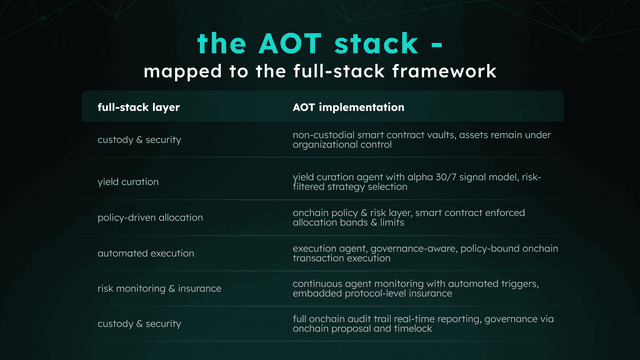
The three gaps identified earlier, fragmentation, operational inefficiency, and lack of systemization, are not solved by better tooling. They are solved by a fundamentally different architecture.
AOT by aarnâ is built on exactly that premise. It is not a yield aggregator, a dashboard, or a DeFi routing layer. It is a fully onchain, programmable treasury system that integrates every layer of treasury operations, from policy definition and capital custody to autonomous execution, risk monitoring, and reporting — into a single, coherent infrastructure.
At its core, AOT is designed around one principle: treasury capital should be actively managed by policy, not by people.
Addressing Fragmentation - One Unified Treasury Layer
The fragmentation problem stems from treasury teams stitching together disconnected tools that were never designed to work together.
AOT replaces that patchwork with an integrated system where every component, vaults, agents, execution, monitoring, and reporting , operates within a single onchain framework.
The infrastructure layer is built on âtv tokenized vaults , modular, structured onchain products that package specific strategies with defined mandates, risk profiles, and governance constraints.
Instead of manually coordinating across protocols, chains, and dashboards, treasury teams access a unified system where capital allocation, execution, and reporting all flow through the same infrastructure.
This extends across Ethereum, Base, giving institutions a single operational layer across the chains that matter, without the overhead of managing each independently Addressing Operational Inefficiency, Autonomous Execution Within Policy Boundaries
The manual execution problem, governance cycles, multisig approvals, bridging, position monitoring, is addressed through AOT's agentic execution layer: âTARS (aarna Tokenized Autonomous Rewards Strategies).
âTARS is a multi-agent system that operates as the intelligence and execution layer of the treasury. It is not a black box. It is a constrained, auditable operator that works entirely within the policy boundaries the organization defines. Three specialized agents coordinate to manage the full execution lifecycle:
-
Yield Curation Agent - continuously scans real-time onchain markets, evaluating opportunities across protocols against risk constraints and the organization's policy framework. It applies aarnâ's proprietary alpha 30/7 signal model to rank and filter eligible strategies, surfacing only those that meet defined criteria.
-
Execution Agent - carries out approved allocations onchain, handling deposits, rebalancing, and maturity rollovers. Every action is validated against governance rules, TVL caps, slippage limits, and position constraints before execution. Nothing moves outside policy.
-
Conversational Agent - provides treasury teams with a plain-language interface to understand strategy performance, review allocations, and adjust parameters, without needing to interact with underlying smart contracts directly.
The result is a treasury that operates continuously and systematically - responding to market conditions in real time, executing rebalances when thresholds are met, and rotating capital as opportunities evolve, without requiring manual intervention at every step.
In practice, this is already demonstrated. During December's live reporting period, âtvPTmax, AOT's first agentic yield vault, allocated capital across nine distinct Pendle PT markets, executed nine automated rebalancing operations, maintained zero risk breaches, and delivered an effective annualized USDC yield of approximately 9%. TVL grew from $150k to $435k over the month with no adverse impact on NAV or realized returns.
Addressing Lack of Systemization - Policy, Risk, and Reporting as Protocol-Level Infrastructure
This is where AOT most directly differentiates from anything currently available in the market.
On Risk - Policy as the Foundation, Not an Afterthought
Rather than leaving risk management to individual judgment calls, AOT embeds risk governance directly into the protocol through a Policy and Risk Layer enforced by smart contracts. Before any capital is deployed, the organization defines:
-
Diversification rules - which assets and venues are permitted
-
Allocation bands and risk ceilings - limits on exposure and concentration per protocol
-
Rebalancing logic and triggers - precise conditions for rotation or de-risking
-
Liquidity buffers - minimum reserves maintained for operational needs
These policies are onchain and auditable. Agents cannot act outside them. Changes require onchain governance with timelocks , nothing material can shift overnight without full visibility.
This transforms risk management from a burden carried by individual team members into a systematic, enforceable framework embedded in the infrastructure itself.
On Protection - Insurance Built Into the Protocol
Insurance and agent error coverage are embedded at the protocol level, not offered as a third-party add-on. For family offices and institutional allocators deploying significant capital onchain, this is a critical distinction.
Protection mechanisms are visible to every stakeholder and governed by the same onchain policy framework as capital allocation.
On Reporting - Full Onchain Transparency
Every allocation, rebalance, and strategy execution within AOT is logged onchain with traceable intent and execution metadata. Treasury teams and their stakeholders have access to real-time visibility across portfolio allocation, yield performance, liquidity availability, and risk exposure, in structured, audit-ready form.
This is not a dashboard built on top of fragmented data. It is native transparency, every action verifiable onchain, every decision tied to an explicit policy rationale.
The Treasury Infrastructure Moment
The organizations that will define the next era of onchain finance are not the ones with the most capital. They are the ones who manage it best.
For too long, onchain treasury management has operated below its potential, not because the opportunities weren't there, but because the infrastructure to access them systematically didn't exist. Capital sat idle. Risk decisions were improvised. Reporting was an afterthought. And the gap between what a treasury could do and what it actually did kept widening.
That gap is now closeable.
The convergence of mature DeFi markets, institutional-grade stablecoin infrastructure, and programmable onchain systems has created the conditions for a fundamentally different approach to treasury management.
One where policy governs risk before capital is ever deployed. Where execution is autonomous, auditable, and continuous. Where every stakeholder , from governance participants to institutional LPs , has real-time visibility into how capital is performing and why.
AOT by aarnâ is built for this moment.
about aarnâ
aarnâ is an advanced DeFi asset management platform, designed at the intersection of AI and DeFi, to help users manage their digital assets lifecycle.